


Showing posts with label Lotus. Show all posts
Showing posts with label Lotus. Show all posts
Sunday, October 10, 2010
Lotus Presented the 1st Hybrid Car

According to Lotus chief designer, Wolf Zimmerman, the company searches now for the partner for a batch production of model since 2014. Also he told that the British motor-car manufacturer wants to create alternative of model of Aston Martin Cygnet and BMW Z4 Coupe.

Friday, October 1, 2010
Live in Paris 2010: 2011 Lotus Esprit 5.0 liter V8 with 620 hp and 720 Nm


Lotus was the hero of the Paris Motor Show, with six new models (including concepts) they could count on most media attention during the unveiling of these models. The new Esprit is a gem, not only the looks are reminiscent of the Lambo-babes, the performance under the hood are equally delicious.
A 5.0 liter V8 with 620 hp and 720 Nm of torque is entirely at your disposal. The sprint to 100 km / h takes just 3.4 seconds to complete and the top speed is 330 km / h. The Lotus weighs 1,450 kilograms, not as light as we are used to them. The start of production end 2012, now he is from 2013.
Lotus Official: 2013 Lotus Esprit first photos and specs


Lotus Esprit in The surname is still famous, partly thanks to James Bond / Roger Moore but also through his line that magnified the cuneiform style and grace in his 4-cylinder engine and 6-valve, a world first for its time.
The Raw Spirit ... 2013 (!) Will be a worthy descendant of his eldest and will certainly not of power: while the original Spirit came out 160 hp from its 2-liter, that of 2013 as spit not less than 620, from 5 liter V8 original Lexus, assisted by a supercharger.
But this Ghost will not be a lightweight because with 1485 kg on the balance, it does not honor the famous "Light is right". But the modern pèsant their weight, and a nice big V8, it would be wrong to blame the Spirit. It may even be equipped with a hybrid system similar to the KERS in Formula 1 last year and in this case, power will increase to 720 hp.
Lotus Official: Lotus Elan 2013 first pictures and basic details


Let us close this chapter in Lotus with the vintage beauty of the Elan 2013 whose task will be to forget the bland design of the 90s, derived from an ordinary Japanese which was thankfully forgotten the name. The new Elan will not disappoint this time fans of the brand because Lotus has done things.
Aesthetically first is the new style of the British manufacturer is out and eyeing the expensive stealth to Lamborghini. Under the hood back, we find a V6 Toyota Genuine who will move the 1295 kg of the beast.
Dual-clutch gearbox and seven reports, 4-liter, 450 hp and 450 Nm of torque, this V6 that is found under the hood of some 4 × 4 Toyota is unrecognizable here. It can even be coupled to a hybrid system, derived from kers preview last year in Formula 1.
Lotus Elise 2015 - Change of era


The new Lotus are numerous, and one of them will change the core of the British brand since has been made the Lotus Elise 2015. This concept car, close enough to the series, illustrates what will be the new generation.
Lotus Official - City Car Concept Lotus first pictures


A real burst of new at Lotus for this world! After the Spirit 2013, the sedan Eterne, Elan Vintage 2013 without counting the Elise concept, here's the legendary British brand that has an amazing concept ... city! What really cover all possible segments.
Quads, 3.50 meters long, 54-KW electric motor assisted by a three-cylinder engine 1.2l petrol / ethanol / 48 hp which serves generator to recharge the batteries, like the Chevrolet Volt here specifications for the quite unusual for a Lotus.
Autonomy in all electric mode would be 60 km but increase to 500 with the engine. Despite his respectable weight of 1,400 kg (!), It would be able, according to the manufacturers to achieve the 0 to 100 km / h in 9 seconds and reach 170 km / h at peak.
Saturday, August 14, 2010
2011 Lotus Sport Cars Elise With Valvematic System Plus Combined dual VVT-i
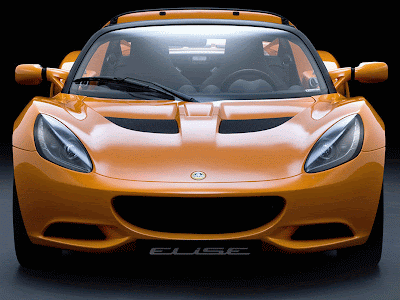
Making its debut at the 80th International Geneva Motorshow, the 2011 model year Lotus Elise introduces a number of changes and improvements to maintain its class leading position. The Lotus Elise revolutionised the sportscar market 14 years ago when the small lightweight agile 2-seat mid engine sportscar was introduced. By ensuring that the Lotus Elise stuck rigidly to Lotus' core values of performance through light weight, the Lotus Elise was able to produce supercar performance with city car economy.
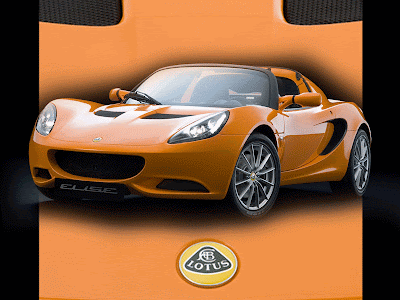
2011 Lotus Sport Cars Elise
The body of the new 2011 Lotus Elise is an evolution of the iconic Elise design, retaining the character and style, while offering a more planted, purposeful stance and a pure, contemporary look that links it to the Evora. As with all Lotus product the design is an exciting blend of dramatic style and functional efficiency. At the rear of the car the new engine has been encased by a distinctive "twin-spine" engine cover whilst lower down a more aggressive diffuser is tightly wrapped by an elegant new bumper design that now includes the rear licence plate.
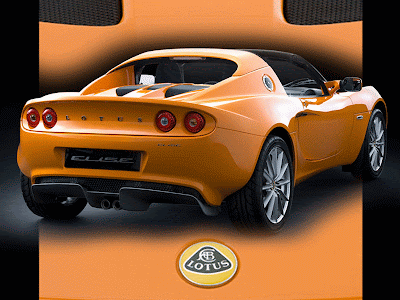
2011 Lotus Sport Cars Elise
New headlamp units with distinctively sculptured LED lighting guides (incorporating daytime running lamps and direction indicators) give a contemporary twist to this classic design. Elsewhere, the signature, Lotus "mouth" and familiar sculptured forms have been sensitively refined to give a crisper, more dynamic look.
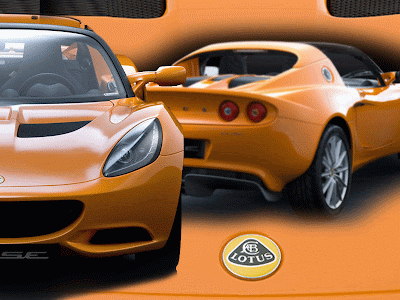
2011 Lotus Sport Cars Elise
The rear boot is now opened from the cockpit rather than via a separate key operation. The high quality feel of the Lotus Elise is continued throughout the car with the Lotus Elise graphic incorporated into the new side LED direction indicators, like those on the Evora. The driving position, from the perfectly positioned pedals and steering wheel, to the comfortable and supportive seats with ProBax technology means that, like all Lotus cars, the driver becomes part of the car rather than being just a passenger. With the sleek new body the aerodynamics have improved giving a reduction in the coefficient of drag of 4%.
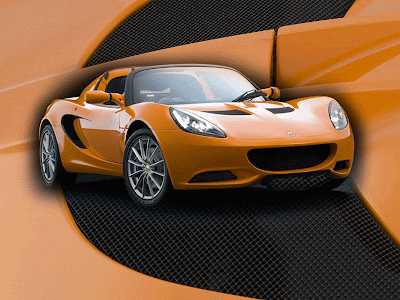
2011 Lotus Sport Cars Elise
The Lotus Elise introduces the new 1598 cm3, 1ZR-FAE engine, provided by Toyota. The key to this engine's performance and efficiency is the Valvematic system (a variable valve lift mechanism), which is combined with the dual VVT-i (Variable Valve Timing-intelligent). The engine continuously controls intake valve opening/closing timing and the intake valve lift to vary the volume of the intake airflow, giving significant improvements in efficiency and fuel economy. This ensures optimal performance based on the engines operational condition, thus helping the Lotus Elise achieve both high fuel efficiency and high performance.
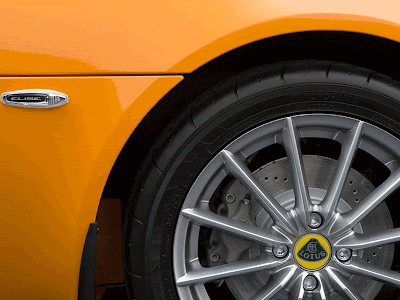
2011 Lotus Sport Cars Elise
First of all, the maximum power output is achieved at near maximum revs (engine speed) of 6800 rpm and maximum torque (a respectable 160 Nm, 118 lb.ft) is reached at 4400 rpm. This gives a good combination of mid range pull but also encourages the driver to rev the engine to the maximum permitted engine speed of 7000 rpm (transient rev limit). Like all Lotus Elise sportscars, there are three shift up lights, on the binnacle cumulatively lighting when the driver is getting closer to the rev limiter and when all three are illuminated, they flash to indicate that the driver is almost on the rev limiter so time to change up a gear! New cast wheels have been designed specifically for the Lotus Elise and the new optional forged wheels weigh just 29.26 kg per set, 2.14 kg lighter than a set of lightweight cast versions. Both are available in silver or black colour.
Andreas Prillmann, Chief Commercial Officer for Lotus Cars said, "In its 14 years of production the Lotus Elise has accounted for 32% of all the 61 years of Lotus production, illustrating how significant to the brand and well loved it is. The 2011 Lotus Elise is greener, purer and more desirable, making it even more relevant to today's marketplace. The new Elise underlines Lotus' reputation as one of the most innovative sports car manufacturers in the world."
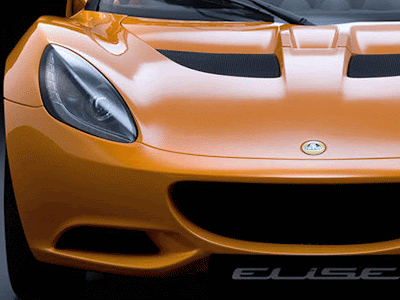
2011 Lotus Sport Cars Elise
The height of the engine cover has been raised by 34mm to accommodate the taller 1ZR engine compared to the previous 1ZZ engine from the outgoing model due, in part, to the additional Valvematic technology included on the new engine. This has given Lotus engineers an opportunity to subtly redesign the rear engine cover to match the design theme from the front and rear of the car.
The legendary Lotus ride and handling gives a superb high performance, sporty drive, combined with a compliant ride and progressive on limit handling, it makes the Lotus Elise a car that demands to be driven.
The entry level Lotus Elise weighs 876 kg, making it one of the lightest fully homologated sportscars in the world. This low weight translates into efficient performance with minimal environmental impact in terms of emissions and fuel consumption. The efficiency of the Lotus Elise structure means that the 136 PS (100 kW, 134 hp) delivers phenomenal performance.
Monday, August 2, 2010
Sport Car: Lotus Sport Exige GT3
 Sport Car Lotus Sport Exige GT3 Black Color
The prototype Lotus Sport Exige GT3 race car was unveiled at the annual FIA GT Championship presentation ceremony outside the world famous Casino in Monte Carlo, Monaco 2nd December 2005th The next day (2 December 2005), the first test vehicle was held at high speed Paul Ricard High Tech Test Track in Southern France under FIA supervision, the first phase of the Lotus Sport Exige GT3 becoming eligible for FIA GT3 competition. This latest FIA series, which will begin in 2006, has been racing cars that have the same power and weight, and that has direct lineage to their road going versions.
Lotus Sport Exige GT3 participants developed the Lotus Sport, the performance arm Lotus Cars and is derived from the standard Lotus Exige coupé model. Weighing about 750 kg, it stays true to "performance through light weight" core Lotus philosophy. The car uses a race prepared 1.8 2ZZ-GE VVTL-i engine with a Roots-type supercharger and air-to-air intercooler that uses Lotus T4e Engine Control Unit to produce 285 hp (289 hp) at 7800 rpm. This gives an impressive power to weight ratio of 380 hp / tonne or 2.6 kg / hp.
After a brief shakedown program Lotus test track at Hethel, factory test driver Gavan Kershaw conducted a final set of chassis tires on the wet morning session at Paul Ricard official FIA test. What followed was a trip to slick tires on the track by FIA nominated test driver drying Christophe Bouchut.
 Sport Car Lotus Sport Exige GT3 Back
Commenting on the encouraging test, Chris Arnold, General Manager of Lotus Sport, explained: "We were delighted to attend the official FIA tests. Since the car was still on the drawing board two months ago, it's a fantastic achievement for the full build-in such a short time. We knew this test would be a first test for the car at the spot, and I am very pleased with the results. Our winter development program began testing the tunnel just before Christmas followed by further work in preparation for the next FIA test in March. "
FIA announced five races of the European Championship for the new GT3 class with rounds in the UK, Germany, Belgium, France and Italy. Various national GT Championships are also considering modifications to its regulations to include GT3 class.
 Sport Car Lotus Sport Exige GT3 Turing
Wednesday, July 21, 2010
2010 Lotus Eagle Exclusive - MYH3KHFHU5G2
 Never mind all the spy photography - here's the first authorised countenance at the 2010 Lotus Eagle, the latest sports car emanating from the concern that pioneer built.
Scheduled for an authorised unveiling at the British motor show on August 22, the Eagle, a 2+2 coupe, is the first all-new Lotus car since the 1995 Elise (the Elise-based Galilean S, apparently, doesn't count).
Designed for enthusiasts who need a little more practicality, the Eagle includes a backseat, although, with provisions to anchor car seats, Lotus admits it's a kids-only zone. While the side trunk was designed to sound a set of golf clubs, customers looking for extra storage expanse may opt for a two-seat model with a load shelf in lieu of the side seats.
Though Lotus provided only one photograph, it crapper be seen that the Eagle's shape seems much more organic and proportionate than that of the Galilean S. We note, however, that the styling is rattling figuring of the M250 concept, originally shown to the public nearly eight years past in Geneva.
Like the Elise, the Eagle sources its engine from Toyota, but this instance in the form of a 3.5-liter V-6. Essentially the same motor found in the pedestrian Camry sedan, Lotus tweaked the engine ever so slightly to yield 280 hp. No performance figures have been released yet, but Lotus claims the car is quicker and more steady around the Nurburgring than the Elise.
Production, expected to total 2000 cars per year, module begin in primeval 2009. Unlike the Galilean S, wait the Eagle, in either 2+2 or two-passenger form, to eventually interbreed the pond into North America.
Saturday, June 26, 2010
SPESIFIKASI Motor Radikal | Lotus dan Proton
SPESIFIKASI Motor Radikal | Lotus dan Proton

The combined company Lotus and Proton is preparing a radical sports car. It is said that because his presence later, the car will shake the luxury car market. Like what?
Obviously, the intention was ambitious enough because Lotus and Proton trying to steal a luxury car market from Porsche, Ferrari and Aston Martin as part of what is called 'The Dawn of a new era. "
As reported by Autocar, Saturday (06/26/2010) starting from the concept of radicalization that Showcase Lotus founder Colin Chapman, that is a car that was 'light and simple'.
Thus, our corporate philosophy will also be changed for future models and concept cars goodbye a complex, high cost manufacturing technique with the upper class.
As expressed by Proton and Lotus Chairman, Datuk Mohd Salleh Mohd Nadzmi which outlines the company's plans to build a car with a new motto, 'Tomorrow's luxury sports cars, today'.
Car will cost an average 110 thousand to 80 thousand pounds, which includes application of technology was a double 7-speed transmission, active aerodynamics, dampers variable, hybrid systems, and alternate fuels.
Its realization will begin with a concept car that had the Golden Proton displayed at the Geneva Motor Show, which offers competition from Aston Martin Cygnet and the Toyota IQ.
Tuesday, June 8, 2010
Lotus Sports Cars Evora Type 124 Endurance Racecar

Proton-owned and British-based sports car maker Lotus has announced the Evora Type 124 Endurance Racecar (pronounced One Twenty Four). Based on the Evora road car, it is powered by a mid-mounted Toyota V6 powerplant. The engine is race-tuned and can output over 400PS, depending on race regulations. The power unit is linked to a 6 speed sequential transmission with steering wheel-mounted paddle shifters. It can weigh less than 1,200 kg, again depending on race regulations, thanks to an aluminium chassis, very strong lightweight forged aluminium wishbones and lightweight composite and carbon fiber panels.

Lotus Sports Cars Evora Type 124 Endurance Racecar
The Lotus Evora Type 124 Endurance Racecar has been developed from the award-winning Evora road car and is built to FIA regulations and safety standards. Based on the standard Evora road car, the Evora Type 124 (pronounced One Twenty-four) will make its 24 hour racing debut at the ADAC Nurburgring 24 hours race. According to Lotus, the Evora was designed for racing from the start and this made it very easy for the team to convert the Evora into a racecar, thanks to the mid-engine layout, stiff bonded aluminium chassis and lightweight forced aluminium wishbones for the suspension.

The Type 124 (pronounced One Twenty Four) Endurance Racecar is the next step in the evolution of the Evora. The car will make its 24 hour racing debut at the ADAC Nürburgring 24 Hours which provides a great test for the Evora’s performance, efficiency and durability under tough and demanding endurance race conditions.

The Evora gets a race-tuned version of the Toyota V6 mated to a 6-speed sequential paddle shift racing gearbox, and it now produces over 400 PS which is well over the 100 PS per liter ratio. I wish they’d listed out more specifications as to the specs of the engine – I dig this kind of stuff. In stock form, the Evora makes 280 horsepower from its 3.5 liter V6 engine, but even for the road car its said that a supercharged version could come later putting out over 400 horses.

At the heart of the Lotus Evora are fundamental racecar elements: mid-engine layout, high-tech and super-stiff extruded and bonded aluminium chassis and very strong lightweight forged aluminium wishbones. All these elements mean that it is a natural evolution from the road going Lotus Evora to a competitive endurance racecar.

From the outset the design team had intentions to take the Evora racing and the chassis was designed with this in mind. Endurance races are the perfect events to showcase the efficiency, handling and durability characteristics that have been fundamental to the concept of the Evora.
The Lotus Evora Type 124 Endurance Racecar has a race-tuned version of the mid-mounted Toyota V6 engine, with power increased to over 400 ps (depending on race regulations). Vehicle mass is expected to be reduced by up to 200 kg, bringing the weight of the racecar to less than 1200 kg (depending on race regulations).

Further changes for the Lotus Evora Type 124 Endurance Racecar include a six speed sequential paddle shift racing gearbox, full FIA specification roll cage, FIA-compliant 120 litre ATL fuel system, FIA fire extinguisher system, competition carbon fibre rear wing, diffuser and front splitter.
The racecar is fitted with AP Racing 6 piston callipers front and rear, with a race-tuned Bosch ABS system, 4-way adjustable dampers and adjustable anti-roll bars. The racecar runs on 18” rims shod with Pirelli racing slicks and the wheels widths have been increased over the roadcar to 9 ½ J on the front and 11 J on the rear.

Loads of goodies are added to the car – AP Racing 6 pot brakes on both front and back, a race-tuned Bosch ABS system, 4-way adjustable dampers, adjustable anti-roll bars, 18 inch wheels (nice and wide 9.5 from and 11 at the rear) with Pirelli slicks, a full FIA rollcage, an FIA 120 liter ATL fuel system, FIA fire extinguisher, yet weight is cut down from the production car to under 1200kg depending on race regulations. This is thanks to the use of carbon fiber extensively in the rear wing, diffuser, font splitter, and body panels.

The aerodynamically efficient Lotus Evora Type 124 Endurance Racecar body design, made from lightweight composite and carbon fibre panels, remains predominantly unchanged from the road car, with the only modifications being to the lower sections of the front and rear clamshells and the side sills.

Luke Bennett, Director of Lotus Cars Limited, said, “Motorsport has been in our blood ever since our founder, Colin Chapman, built the first Lotus back in 1948. We are proud of our motorsport history, which includes victories in Formula One, Le Mans, saloon car, rally car and sportscar racing around the world; more recently, we won the British GT3 Championship in 2006 with the Lotus Exige. The Lotus Evora Type 124 Endurance Racecar is from the same unique stable and we expect it to be a competitive racecar when we enter various endurance races next year.”

Roger Becker, Vehicle Engineering Director for Group Lotus Plc said, “Every Lotus car is designed to be at home on the race track as well as the road, and the Evora is no different. Designed primarily as an everyday road car, the Evora’s lightweight and stiff structure, its aerodynamics and performance means that it is perfectly suited to taming race tracks around the world, and we are looking forward to seeing the new Lotus Evora Type 124 Endurance Racecar line up on the grid for the 2010 season.”

The racecar is expected to compete in a number of endurance races in 2010/ 2011 forming part of a factory-supported race program. The races that are targeted are: The 2010 ADAC Nürburgring 24 Hours (Nürburgring Nordschleife, Germany) in May 2010, Merdeka Millennium 12 Hours (Sepang, Malaysia) in August 2010, BritCar 24 Hours (Silverstone, UK) in October 2010 and the Dubai 24 Hours (Dubai Autodrome, UAE) January 2011.
Subscribe to:
Posts (Atom)
LinkWithin


